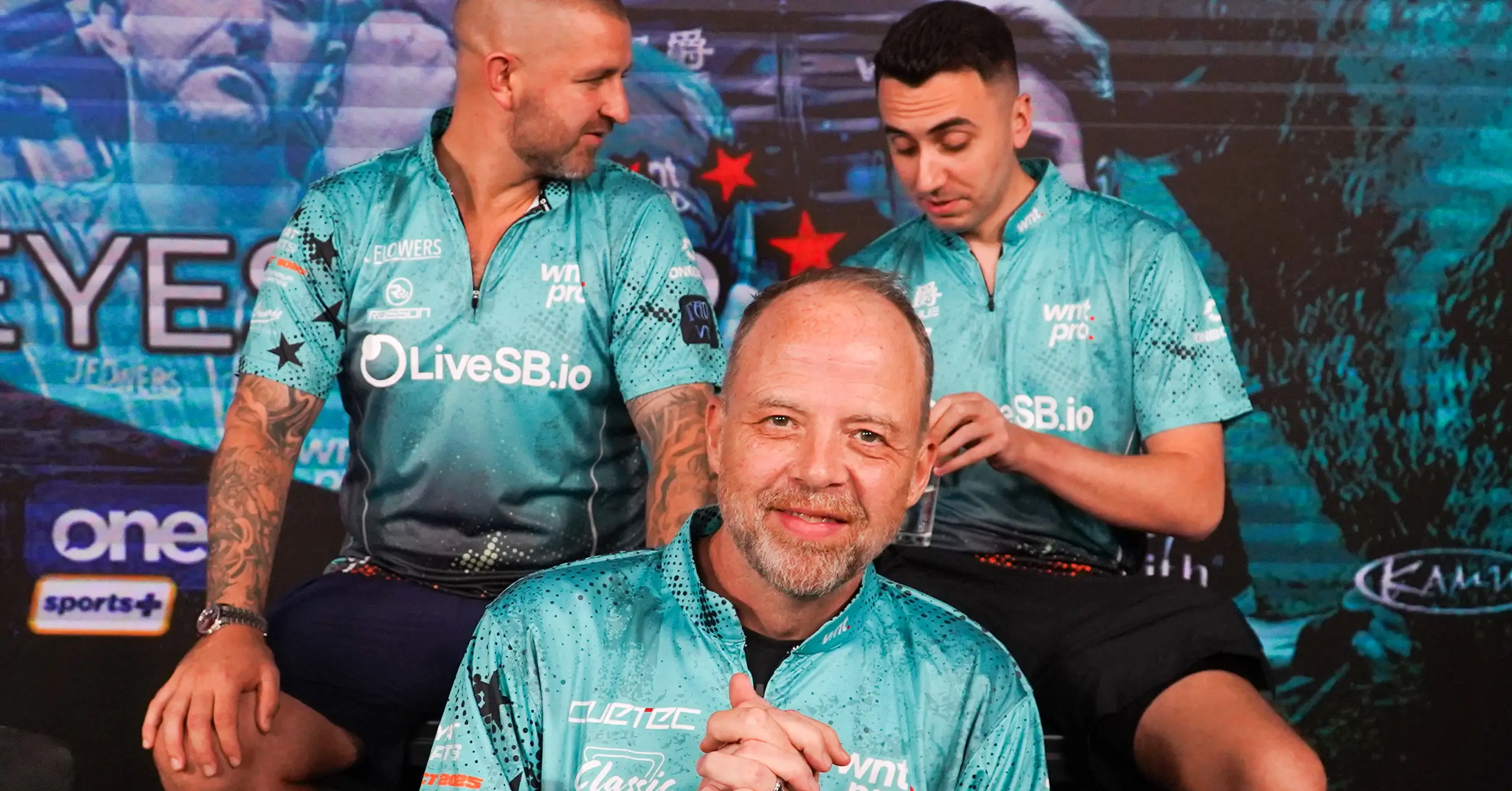
American pool legend Jeremy Jones has always had a special relationship with Efren Reyes, both as a friend and a fellow competitor.
Jeremy Jones, the former American pool player-turned-TV analyst, and Efren Reyes, who needs no introduction, go way back. All the way back to when Efren was known by another name.
Legend has it that after Filipino pool shark Jose “Amang” Parica, who was Efren before Efren, began making a name for himself in the American pool circuit in the early 1980s, he reportedly said that he wasn’t even the best player from the Philippines, that they needed to watch out for this guy named Efren Reyes.
Word supposedly got back to Efren, so when it was his turn to try his luck Stateside, he decided to use an alias. One of the American players whom he first met was Jones.
“I’ve known him for a long time,” Jones told The GAME during the press conference for the 2025 LiveSB.io Reyes Cup. “He used to stay where I’m from in Houston, where he won his first big tournament in America under the name Cesar Morales, his alias.
“He was supposed to be a guy from San Antonio, but Hispanic.”
Whichever name he used, Efren Reyes eventually became a popular figure in the US, continuing what Parica started and paving the way for more Filipino cue artists to come over.
Jones, who will captain Team Rest of the World against Django Bustamante’s Team Asia in the Reyes Cup, which unfolds tonight at the Ninoy Aquino Stadium, is still amazed by how popular pool is in the Philippines.
“I think just comparatively, there’s some bigger sports in other countries. Our country has some bigger sports. Just the way the people endear their champions, I think, overall in the billiards makes a huge difference.”
The culture here, Jones believes, is driven by the Filipino pool icons like Efren.
“I think the champions themselves make a huge difference to the culture here. When I first came here in 2001, I think it was, I used to walk around the streets with Efren Reyes. And he was so generous with his time, and not only a few pesos here and there to the people.
“He truly, you know, was part of the people. And I think that word spreads quickly, just like anything does in the pool world. And I think that really lends the hand to what’s created here in the last 20, 30 years.
“When I first came here, actually, when I came into the airport the first time, they had a big poster of him and Django and Johnny Archer and Earl Strickland. And so that right there, just when I first stepped on Filipino soil, you could tell.”
Many other Filipinos followed in Reyes’s footsteps, most of whom also made their mark internationally. As recently as this year, Carlo Biado crowned himself world champion. Jones thinks the Filipino pool style is unique and has improved through the years.
“You could say they did it their own way for a long time. Even from one player to the next, it was very unique. But like most players, when they’re striking the ball, it was very much the same, even though a lot of things were different.
“Now, today’s game, I think they’re a little bit more about technique. They understand the difference. Even Efren would tell you these days that he wishes he would work on technique a little more back when he was younger.
“But he was a phenomenal mind. And I think he kind of made it that way to where you could do it a little different and still be incredible.”
For this year’s Reyes Cup, Jones will make the switch from commentator during last year’s inaugural tournament to non-playing captain. Last year, Team Asia walloped Team Europe.
Jones hopes the outcome will be different this time. With a larger pool of players to select, he was able to snag world no. 1 Fedor Gorst of the United States, who will team up with Scotland’s Jayson Shaw, 2025 Hanoi Open runner-up Moritz Neuhausen of Germany, American Skylar Woodward, and Spain’s Francisco Sanchez Ruiz.
Over four playing days, they will battle Team Asia, composed of Biado, Johann Chua, Aloysius Yapp, Duong Quoc Hoang, and 19-year-old prodigy AJ Manas.
“Team Asia is a very similar team,” Jones said. “They don’t always hold up, but leads do hold up most of the time in these team events, especially if you get a three or four-point lead.
“I think lineups could have been a little better for Team Europe last year. They weren’t terrible, but I think they could have been a little bit better. And the key is to try and play better every day. And that’s definitely something that Team Asia did last year, but definitely something that Team Europe did not do last year.
“So you’re not going to win it on day one. It’s not about day one. It’s about trying to win the sessions and then trying to improve as the days go on.”
Banner images from Matchroom Sport
Related Stories