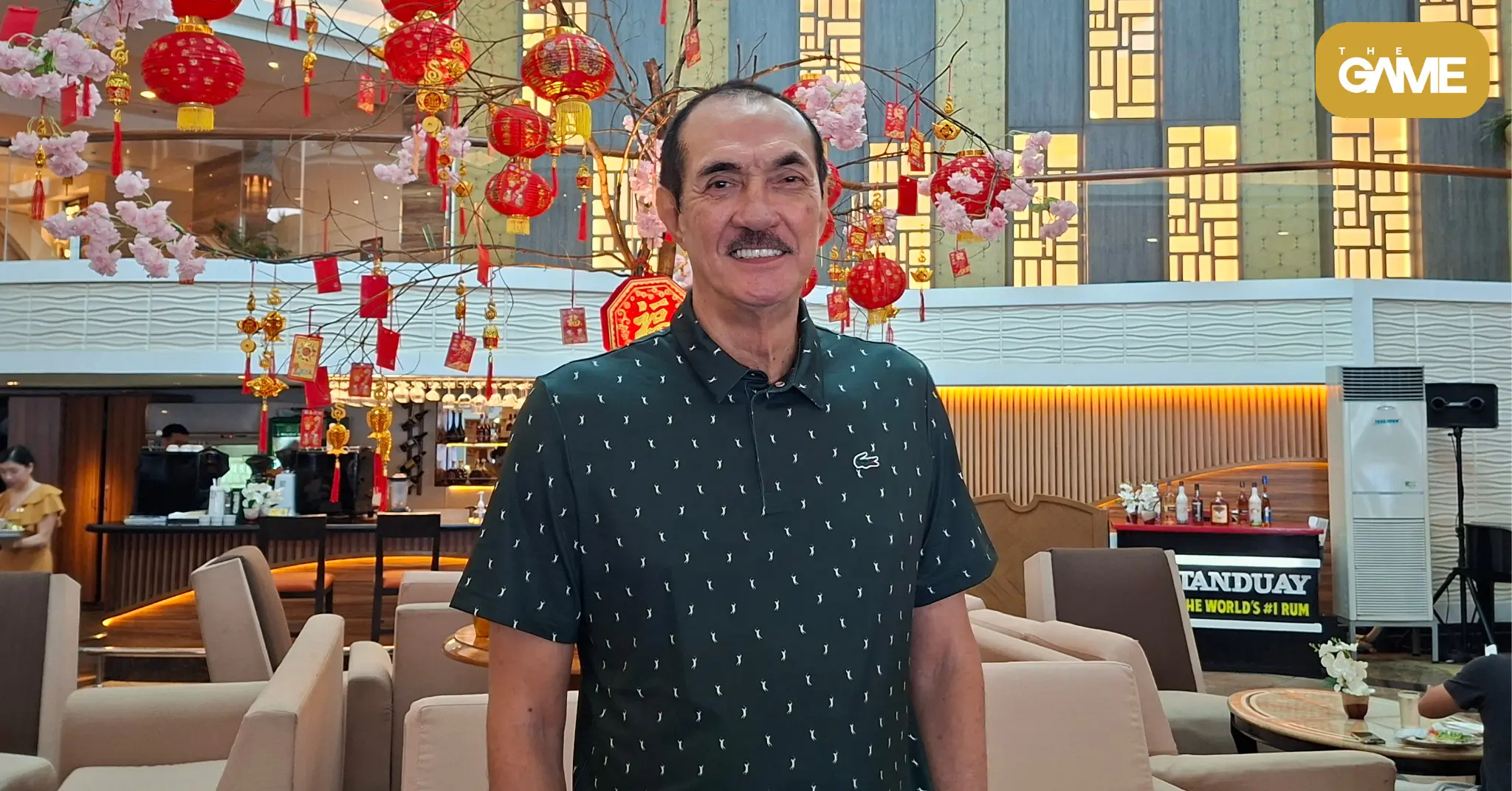
Having the PBA Finals MVP named after him is an acknowledgement of the greatness of Ramon Fernandez.
Some years ago, Ramon Fernandez and his wife Karla were vacationing in Taiwan, like many Filipinos are wont to do. They were sightseeing around the capital Taipei, and after turning a corner, found themselves in a tight alley.
Suddenly, someone recognized the tall, six-foot-five frame of Fernandez, and before you could say “The Elegant Shot”, the couple found themselves surrounded by fellow Filipinos, both co-tourists and overseas workers, all wanting to take a selfie or to simply greet the PBA legend.
Soon, the foot traffic in the narrow alleyway had come to a stop and was backed up to the main street, and the locals began wondering who was this tall Filipino tourist attracting so much attention.
If any of the locals had bothered to ask any of the Filipinos who were mobbing this stranger, it’s fair to wonder what answer they might have received.
That’s Ramon Fernandez, greatest PBA player of all time would be as good a guess as any, especially if the one being asked is from Generation X.
“It’s like that wherever we go around the world,” Karla told The GAME in an exclusive interview. “Europe, the United States, it doesn’t matter. Filipinos always gravitate towards Mon.”
During the 2021 Hanoi Southeast Asian Games, where Fernandez served as chef de mission of the Philippine delegation, his locally-assigned liaison officer was equal parts frustrated and puzzled at why they couldn’t cross the street or walk from here to there without a Filipino fan interrupting their stride.
It was only after she decided to Google “Ramon Fernandez” that she finally understood. She had been in the presence of Filipino basketball royalty all this time.
Legacy of greatness
Whether Ramon Fernandez is, in fact, the greatest PBA player of all time or a close second to June Mar Fajardo is very similar to the Jordan vs. LeBron debate: it’s essentially one generation’s opinion against another’s.
The man himself doesn’t want to wade into this discussion.
“I’d rather leave that to the basketball fans to decide,” Fernandez told The GAME. “I’m pretty sure not everybody would… iba-iba ang pipiliin ng karamihan depending sa kung sino ang mga nasusundan nila. So that would be best left to the fans to say.”
Younger fans always point to Fajardo’s unreal MVP count (nine, more than double Fernandez’s four) as the end of this debate. While that certainly can’t be ignored, along with the fact that Fajardo would most probably win a hypothetical one-on-one duel between the two, what cannot be disputed is this: Ramon Fernandez is the greatest winner in PBA history. And at the end of the day, competitive sports is about winning.
To this end, consider these statistics that lean in Don Ramon’s favor. Fernandez has won the most championships in league history with 19. He’s won more games than Fajardo has played. He was the best player on at least two championships teams each with Toyota, Tanduay and San Miguel. And, although he won “only” four MVPs, he did so with a different team each time, proving that wherever he went he was a winner.
And yet, there was always something lacking from Mon Fernandez’s list of accolades: proper validation from the PBA. Yes, his number 19 was retired by the San Miguel Beermen, and yes, his name is scattered across the league’s record books. But there was no tangible, official recognition.
All that changed several weeks ago when Fernandez received a call from league statistician Fidel Mangonon III. Would he agree, Mangonon asked, to have the Finals MVP award named after him?
“It was Fidel who told me about it,” Fernandez said, “if I was willing to say yes or accept the offer to name the MVP (after me). So I said, ‘Oh, definitely, Fidel. That’s a big honor for me and a humbling experience for me so I will gladly accept it.’”
What was his first reaction, though?
“Well, of course parang may nagsampal sa mukha ko na ganoon. Hindi ako makapaniwala na mangyayari yun.
“I wasn’t really expecting any accolades from the PBA since matagal na rin akong nawala and I seldom watch na nga except for maybe semifinals or the championship series. Nagulat talaga ako, para akong nagising sa panaginip bigla.”
Given that Ramon Fernandez participated in a record 30 PBA Finals over a 20-season career, having the PBA Finals trophy named after him makes perfect sense. But there’s also a bit of irony that he never won the award, as it was instituted only in 1996, almost two seasons after he retired.
The mind is free to wonder how many Finals MVP trophies Fernandez would have taken home if the award had been there since the league’s inception.
“That would be hard to say,” Fernandez said. “I’ll have to dig up the statistics, whether I would qualify for that or not because I’d like to believe that the statistics would tell us exactly how each player performs in a given series or championship series. it’s really the statistics will tell you.”
But when pressed, El Presidente didn’t hold back.
“I don’t want to speculate on that,” he said with a twinkle in his eye, “because if you ask me I will say all of it.”
Full circle: El Presidente to The Kraken
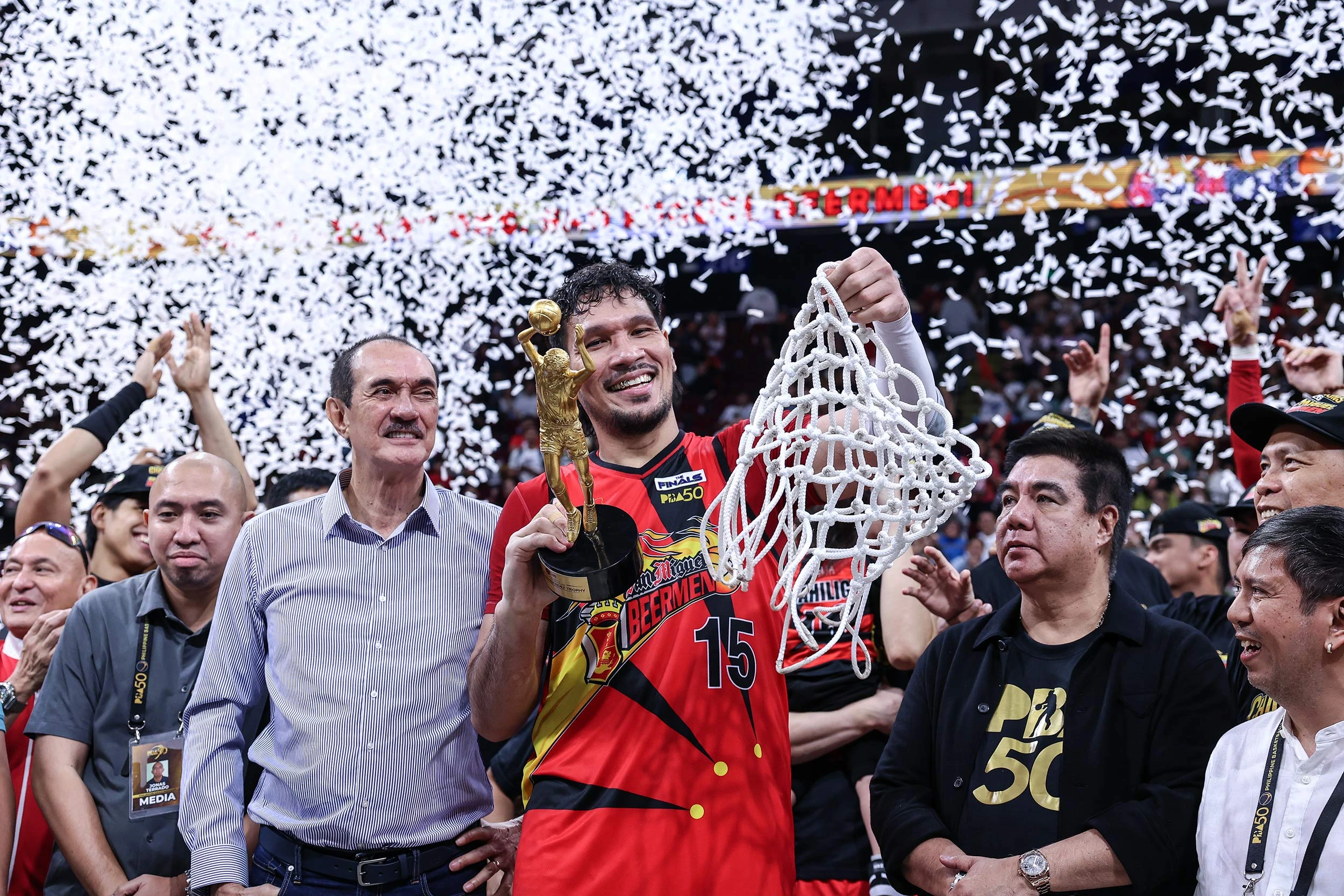
On February 1, 2026, the San Miguel Beermen finished off the TNT Tropang 5G in Game 6 of the PBA Season 50 Philippine Cup Finals to capture their 31st PBA title.
Ramon Fernandez and his wife had flown in to Manila from Cebu three days earlier, or a day after TNT had tied up the series 2-2. Fernandez was scheduled to hand out the award named after him for the very first time, and that moment finally arrived in Game 6.
As the game clock was winding down and the Beermen unassailably ahead, there was virtually no doubt that Fajardo would be the first recipient of the Ramon Fernandez Finals MVP trophy after he averaged 19.7 points and 18.3 rebounds in the Finals.
Seeing Fernandez present the trophy, which depicted him executing his patented Elegant Shot, was a full circle moment many times over.
There was Fernandez, who first played for the San Miguel Braves in the old MICAA and last played for the San Miguel Beermen in the PBA, feting Fajardo, the San Miguel franchise’s cornerstone and the league’s most dominant player since 2012.
It was truly fitting that Fajardo would be the first winner of an award named after the very player against whom he has constantly been compared. Fernandez has always spoken very highly of Fajardo, whom he helped train when The Kraken was still a gangling teenager at the University of Cebu.
“Well, I said from the very beginning it’s really only his physical condition that will be able to limit his MVP awards,” said El Presidente. “That’s why sinabi ko from the very beginning huwag lang siya ma-injure, he will win a truckload of MVPs. He’s bound to win a few more MVPs if San Miguel continues to win.”
There’s not a tinge of jealousy or condescendence in Fernandez’s voice when he talks about Fajardo. He sounds genuinely happy for the success of his fellow Cebuano. And yet, he couldn’t help but listen intently as I rattled off and compared their career statistics.
In terms of scoring, it was about even with both players averaging around 17.7 points per game for their careers. Fajardo had the clear edge in rebounds (12.8 to 8.1), but Fernandez had more assists (4.9 to 1.2) and blocks (1.5 to 1.2).
Clearly, Ramon Fernandez had one of the most well-rounded games in PBA history. He also competed in an era where players were much more physical and referees allowed so much stuff that would be outlawed in today’s game. Plus, he put up those numbers during a stretch of PBA history when teams were allowed to sign up two imports at a time.
One can’t help but wonder, then, how his game would translate in the current PBA. As it is, he was already ahead of his time as a six-foot-five center who could run the floor effortlessly, bring up the ball, and pass to an open teammate.
“I guess center, forward, both or I might even have to shift to point guard for that matter,” Fernandez said when asked what position he would play in 2026. “I think I would be able to adapt to any position. I may have to improve a lot on my outside shooting, develop the three-point (shot).
“If it’s not as physical as before, I believe that would favor me considering my heft and weight.”
As we were winding down our conversation, a young man shyly approached our table and asked Fernandez if he would walk over to theirs for a group photo. He readily obliged, of course.
Karla smiled a knowing smile. “It’s like this wherever we go.”
Greatness manifests itself all the time.
Banner images by Sid Ventura
Frequently Asked Questions
The PBA named its Finals MVP award after Ramon Fernandez in recognition of his status as the league’s all-time leader in championships, with 19 titles across his 20-season career, even though the award was only instituted in 1996, after he had already retired.
June Mar Fajardo was the first recipient of the Ramon Fernandez Finals MVP trophy, presented by Fernandez himself after Fajardo averaged 19.7 points and 18.3 rebounds in San Miguel’s Season 50 Philippine Cup Finals win over TNT.
Ramon Fernandez won four MVP awards across four different teams, compared to Fajardo’s nine MVP awards, though Fernandez holds the record for most PBA championships with 19.
Both players averaged around 17.7 points per game for their careers. Fajardo held the edge in rebounds (12.8 to 8.1), while Fernandez had more assists (4.9 to 1.2) and blocks (1.5 to 1.2).
Yes, Ramon Fernandez helped train Fajardo when he was still a teenager at the University of Cebu, and Fernandez has said only injuries would limit how many MVP awards Fajardo could eventually win.
Related Stories